Have you seen your website traffic fall? AI search could well be the reason, as people are using tools like ChatGPT more and more to find the information they need. So, how do you optimise your website for AI search?
In my latest blog post, I share my top tips to ensure you stay visible online.
Introduction
If you’ve searched on Google recently, you’ve probably noticed those AI overviews appearing at the top of many results pages. In many cases, you can now get the answer you need without clicking on a single website.
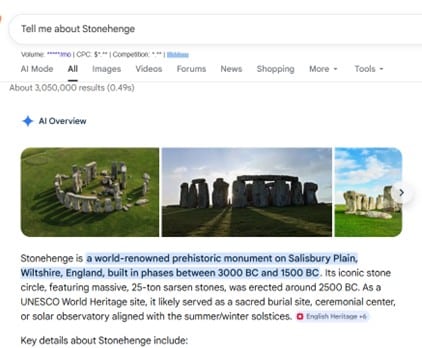
The shift is already affecting website traffic and many businesses are wondering what this means for them. At the same time, people are increasingly using AI tools like ChatGPT, Perplexity and Claude to find the information they need – rather than using Google or other search engines.
Recent research indicates that ChatGPT has already taken 12% of search traffic that traditionally went to Google (study by Patrick Stox and Ahrefs) – quite astonishing given that AI tools have only been around for three years or so. Many experts are calling this the start of the ‘zero-click era’.
So, what does this mean for you as a small business owner?
- How do you optimise your website for AI search?
- How do you get name-checked by ChatGPT or Perplexity?
- And is this the end of Google search as we know it
Let’s start with how the search market is changing.
How search is changing
Traditionally, you’d type a query into Google and scroll through a list of links. It’s then up to you to decide which link to click to find the information you need. AI search changes that.
Tools like ChatGPT and Perplexity generate direct answers to your questions. Instead of browsing multiple websites, you get a tailored response instantly, which often summarises information from several sources. It’s faster and more personalised. And, of course, if you’re a business owner, you’ll want your web copy to be included in those AI-generated answers.
What is GEO?
Generative Engine Optimisation (GEO) is the process of optimising content so it can be found and cited by AI search tools such as ChatGPT and Perplexity.
Instead of simply ranking in traditional search results, GEO focuses on creating authoritative content that AI systems can include in their generated answers.
What does this mean for SEO?

But before you start worrying that all your SEO efforts have been in vain, don’t panic. If you’re already creating valuable, well-structured content that answers real questions, you’re on the right track. The fundamentals haven’t changed; Google still has the lion’s share of the search market (although that may change in time). Right now, SEO and AI optimisation need to go hand in hand.
As digital marketing expert Andy Lambert says, “Most AI answers are built from retrieved web content. If you’re not discoverable on the web, you likely won’t be discoverable in AI answers either. The fundamentals: crawlable sites, fast pages, structured content, and topical authority are still the foundations.”
But some so-called GEO search experts are fuelling unnecessary panic, claiming businesses need expensive AI search solutions on their websites – or even entirely separate AI-optimised sites. In reality, you don’t need a second website or costly consultants. What you really need to do is refine your existing approach to help you optimise your website for AI search.
How can you optimise your website for AI search?
1. Create genuinely helpful content
Creating high-quality content is still your main goal (and will help you get found in Google and AI searches).
Share specific insights rather than generic advice. Depth of content (usually) matters more than breadth. Don’t just trot out facts and figures. Provide some context, explanation and reasoning. Share your take. Demonstrate your expertise by sharing real-life examples and case studies. Talk about the ‘what’, ‘why’, ‘when’ and ‘how’ behind what you do.
Make sure you cover semantically related keywords in your content to help LLMs understand what your content is about (but you should be doing this anyway in line with good SEO practice).
Include data where possible – statistics receive around 40% higher citation rates than qualitative statements.
Consider building topic-focused information pages on your website to strengthen your topical authority.
2. Answer questions with rounded (not just keyword-focused) responses.
Traditionally, people search for relatively short terms on Google but AI queries tend to be longer and more conversational:
Keyword-centric search phrase (typical Google search):
Employment lawyer London
More conversational AI prompts (e.g. in ChatGPT):
Can you recommend an employment lawyer in London who specialises in unfair dismissal cases?
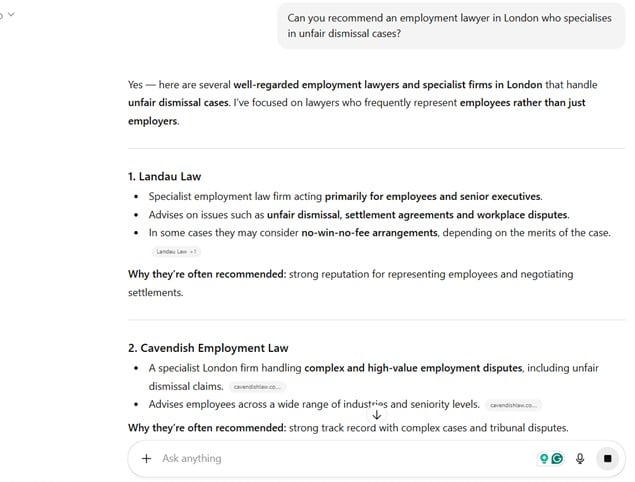
Instead of focusing purely on keywords, think about:
- The questions your ideal client would ask (and their follow-up questions)
- The deeper context behind their search.
Large Language Models (LLMs) use a technique called query fan-out, in which a single user question is broken into multiple related queries to generate a better response.
This means your content needs to show a rounded, detailed understanding of a topic and a less keyword-centric approach. Ensure you cover all aspects of a query.
If you sell a CRM, for example, don’t just describe the product. Cover:
- Features
- Benefits
- Pricing
- Comparisons
Think about the range of questions a user might ask. In-depth information performs better than thin content.
3. Structure your content clearly
Make sure your content is easy to read and scan. AI prefers well-structured content.
Check your content for:
- Short paragraphs
- Concise sentences
- White space (to aid readability)
- Bullet points and lists to break up chunks of copy (AI can easily extract data from tables)
- Clear, descriptive headings. Use H1, H2 and H3 headings (for SEO)
Good structure helps users navigate your web pages, but it also helps search engines and LLMs process your content more easily. This will help you optimise your website for AI search.
4. Long vs short content
Longer, in-depth content (2,000+ words) is often cited more frequently by AI tools, particularly when answering complex questions. So think about how you could create longer-form content – for example, through topic pages or FAQs.
FAQs can provide a helpful format for your website because they mimic the prompt (question) and answer format AI tools use.
5. Keep your content fresh
Regularly updating your content can increase your chances of being cited in both search results and AI-generated answers. Make sure you’re adding regular blogs and new information pages. Update existing blogs with the latest industry insights, research and new examples/case studies.
It’s good SEO practice and vital for AI search visibility.
6. Getting featured in AI overviews
The rise in AI search presents opportunities (as well as challenges) to get your business in front of new customers. AI overviews sit above the ads and organic search results – taking up a huge amount of real estate. Being featured can massively boost brand awareness.
Currently, AI overviews tend to appear more often for informational searches than purely commercial ones. One study showed that 88% of AI overviews target informational queries.
This means that educational content – such as explainers, blogs and white papers – is summarised or cited more frequently than service pages. However, this will undoubtedly change as Google expands AI Overviews into more commercial queries.
7. Make sure you have the right technical foundations in place
Focus on technical SEO – so both search engines and LLMs can crawl and process your content.
Check for:
- crawlability
- mobile optimisation
- page speed
- clear HTML structure.
But this all falls within SEO good practice in any case.
8. Add schema markup
Schema markup (structured data) helps search engines and AI better understand and categorise your content. Structured data makes it easier for AI to interpret the context and relevance of your content, increasing the chance of it being included in rich results (source: exponent21). Products with comprehensive schema markup appear in AI recommendations 3–5 times more frequently than those without.
Consider other schema types as well (such as product, FAQ, article, and author schema). It’s worth speaking with your web developer about implementing this across your site.
9. Think about your wider digital presence when optimising your website for AI search

When searching for information, AI looks for signals of expertise and trustworthiness. So, it’s important to build a strong digital presence away from your website, too. s digital marketing expert Jonathon Saipe said this week on LinkedIn, ‘…we are fast entering an era of optimising for presence…If your audience are getting their answers at the LLM touchpoint, being the source that the AI trusts is becoming more important than the blue link itself.’
AI tools looks foe authority by analysing published articles, backlinks and social media engagement. So, you need to think beyond your website (Source: Xponent21). AI tools pull content from platforms like:
- Wikipedia
- YouTube.
Focus on:
- strengthening your LinkedIn presence
- creating YouTube videos
- appearing on relevant industry podcasts
- listing your business in industry directories
- giving talks at events
- keeping your Google Business Profile up to date.
This can present challenges for smaller businesses that often lack the resources to build a strong presence across multiple platforms. So, my advice is to focus on the most relevant platforms for your business. You might decide that’s LinkedIn or, if you enjoy creating videos, YouTube. Play to your strengths.
10. AI favours trusted sources
AI tools look for evidence of expert authorship and brand reputations as signals of your content’s trustworthiness and credibility.
You can strengthen your credibility and optimise your website for AI search by:
- adding bios to your blog posts
- regularly updating your insights
- citing reputable sources and studies
- linking to authoritative websites
- adding social proof.
Backlinks and third-party mentions will also be seen as a strong signal of authoritiveness and trustworthiness.
This will increase the likelihood that your content will be cited. It also aligns with Google’s E-E-A-T principles (Experience, Expertise, Authoritativeness and Trustworthiness).
How to optimise your website for AI search – a summary
There’s no doubt that we’re seeing a seismic shift in the way people search for and discover information. We’re only at the beginning of what AI can do, and the landscape is evolving fast. Is this the end of SEO? No. But it does mean refining our approach to help optimise your website for AI search.
Here’s a quick checklist summarising the key points from this post.
How do you optimise your website for AI search?
- Make sure you’re creating helpful content that answers real questions
- Demonstrate your subject-matter knowledge with real examples
- Cover topics in-depth rather than producing thin content
- Structure your pages well with clear headings, short paragraphs and bullet points
- Refresh your content regularly
- Add schema markup wherever possible
- Build a wider online presence across digital platforms
The businesses that succeed in the long term won’t be the ones chasing quick SEO or GEO fixes. They’ll be the ones creating genuinely helpful content. Provided your content ticks those boxes, you’ll be well-placed to stay visible in the long term as search continues to evolve. As digital marketing expert Andy Lambert said, “AI isn’t a replacement for SEO; it’s an extension of it.”
If you enjoyed this blog on how to optimise your website for AI search, you might also be interested in:
Credit for main image: Photo by Berke Citak on Unsplash
Footnote: I’d like to acknowledge the thought leadership of Nikki Pilkington and Emily Hill, whose insights (amongst others) have inspired me to research this field more widely and write this blog.