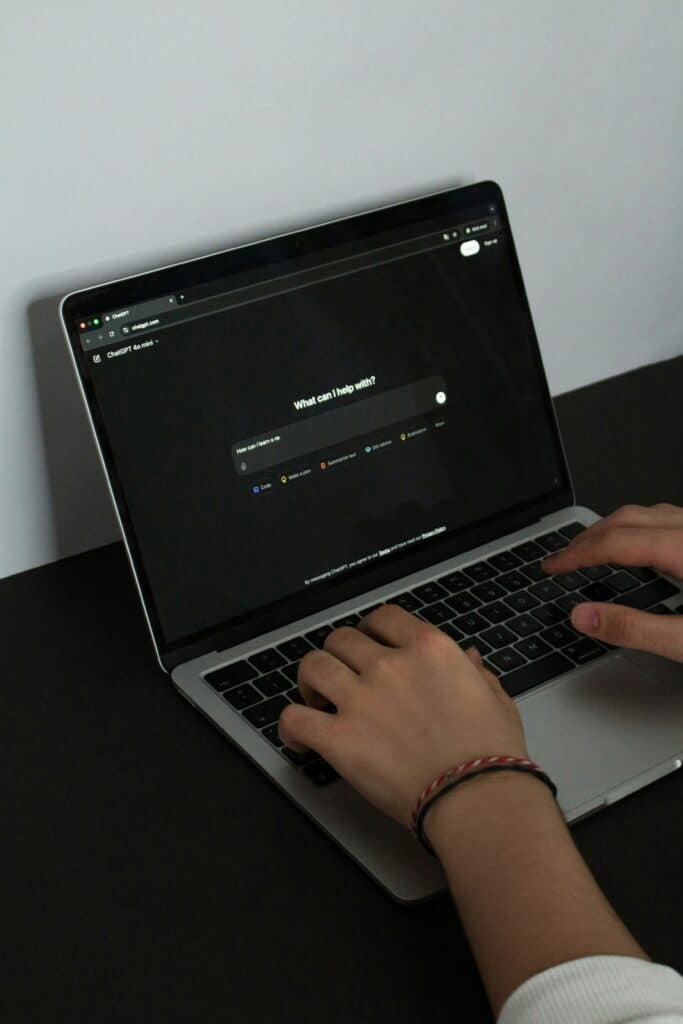
At a time when students consume content in an ever-growing number of ways, higher education marketing teams are under increasing pressure to produce content faster and at lower cost.
And now AI’s rocked up to take the pain away – a tool that can help you draft blogs, social posts, course content and more within seconds. What’s not to like?
The appeal of creating a never-ending stream of new content is undeniable, but could we be losing the heart and soul of our marketing?
In my latest blog post, I’ll share my thoughts on how higher education marketers can retain their distinctive human voice while still benefitting from the time and efficiency gains of AI tools.
People buy from people
There’s no doubt that AI is transforming higher education marketing. And there’s no denying that AI tools are brilliant for ideas, outlines, and research (provided you check the facts and sources properly). AI can even write a passable first draft for you. But typically, the content can be pretty soul-less. And you need something that really connects with your audiences of prospective students, parents, alumni, staff and collaborators.
Universities are not selling products – they’re selling one of life’s greatest experiences – the ‘best years of your life’ and all that jazz. So, yes, you want to tell prospective students about your course and university rankings, but these won’t seal the deal on their own. Students don’t choose a university off the back of facts and figures. They want to find somewhere they’ll feel at home, find their tribe and make memories.
These decisions aren’t rational – they’re based on emotions. And AI doesn’t have lived experience. ChatGPT or Claude can’t relate to the thrill of meeting your first love at the winter ball or scoring your first goal for the university football team. But, as a human being, you can. That’s why there will always be a place for a human writer in higher education marketing.
Putting student stories at the heart of your higher education marketing
One of the most effective ways to create that emotional connection is through storytelling.
Stories are often one of the best-performing formats in the higher education marketing mix, whether it’s sharing how a student has overcome challenges or how a researcher has pioneered a breakthrough treatment for a deadly disease.
Human communicators are the people who uncover these stories. In my work, I spend a lot of time interviewing students and alumni from Saïd Business School at the University of Oxford. Interviewing is a skill in its own right. You need to ask the right questions (and the right follow-up questions), build rapport and uncover the unexpected details that bring a story to life.
Some interviewees are guarded. Some wear their hearts on their sleeves. Others can happily talk for hours (I think my longest interview lasted 2.5 hours!)
These conversations are often nuanced and unpredictable. Turning that raw material into a compelling story that resonates with readers requires empathy, judgement and experience. Finding the right tone isn’t something you can delegate to a robot. Of course, AI can help you with research before the interview, finesse your interview questions or even polish a draft. But let the human do the actual writing.
These kinds of authentic stories don’t just create emotional connections with prospective students. They also help universities stand out in a market where many institutions can sound remarkably similar.
Sounding samey
This challenge of standing out has always existed in higher education marketing, but AI risks making it even harder.
AI is trained on millions of pages of existing content, including university websites, prospectuses, magazines and social media posts. So, when you enter a generic prompt into ChatGPT asking for a 200-word summary of your Maths BSc, it’s likely to produce something generic in return.
You’ve seen the type of content. It’s everywhere, with lots of references to:
- ‘cutting-edge technology and labs’
- ‘real-world thinking’
- ‘world-class teaching’
- ‘a vibrant student experience’
There’s nothing inherently wrong with these phrases. The problem is that almost every university is saying something similar.
In many ways, AI is magnifying a challenge that has always existed in the crowded higher education market: how do you differentiate your institution amongst a sea of sameness?
It takes a human to identify and articulate what genuinely makes your university different, rather than simply recycling well-worn sector clichés.
Talking your readers’ language
Of course, uncovering a great story is only half the challenge. You also need to know how to tell that story to different audiences.
In higher education marketing, you’ll often be communicating with a variety of audiences, including:
- Prospective students
- Current students
- Parents and guardians
- Academics
- Alumni
- Researchers
- Partners
Each audience requires a different approach, tone and style.
One day, you might be encouraging prospective students to attend an open day. The next, you could be communicating sensitive information about staff redundancies or organisational change.
Understanding those differences and adapting your messaging accordingly is a distinctly human skill. Relying too heavily on AI risks getting it badly wrong.
Quality over content
Of course, good content is not just about writing; it’s also about deciding what to say and when to say it. AI can draft a web page or article in seconds, but it can’t see the wider context.
As human communicators, we consider the bigger picture:
- Will this piece of content resonate with readers?
- Is it the right time to publish this content?
- Are there any sensitivities?
- Does it support our wider objectives?
This takes years of experience from skilled marketers who understand the higher education market and the institution. It’s not about churning out lots of content but the right content.
My take on AI
I’m not trying to dissuade you from using AI for your higher education content. AI definitely has a role to play in:
- Content ideas
- Research
- Outlines
- Editing
- Content repurposing
But a human needs to be responsible for:
- Strategy
- Editorial judgement
- Interviewing and relationship building
- Story building
- Audience segmentation and tone of voice
The smart marketers will be those who use AI but keep a human voice at the heart of their writing.
If you’re looking for words written by a human being, why not take a look at my dedicated page on copywriting for universities? I’ve written for some of the UK’s top universities and I’d love to help with your higher education marketing.
Photo credit: Brooke Cagle on Unsplash.